Skip to content

Volume reference

Pool Volume Chart: Common Pool Sizes in Gallons

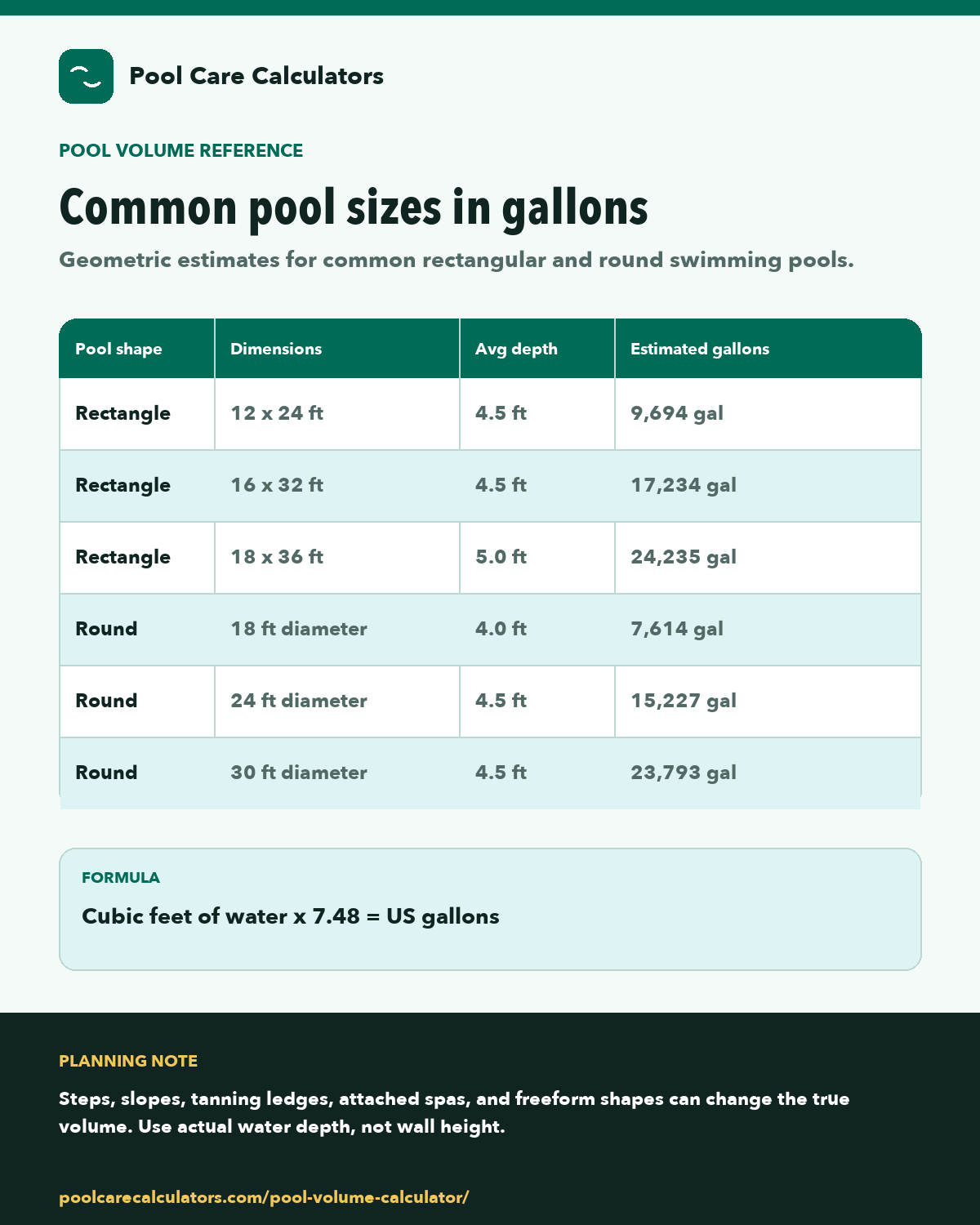
Use this pool volume chart to estimate gallons for common round and rectangular pools. It uses cubic feet x 7.48 gallons and should be checked with the volume calculator for custom shapes.

Reference chart

Common values for quick planning.

These values are for planning and checking mental math. Use the matching calculator when your pool size, product strength, target range, or current test reading differs.

Pool shapeDimensionsAvg depthEstimated gallons
Rectangle12 x 24 ft4.5 ft9,694 gal
Rectangle16 x 32 ft4.5 ft17,234 gal
Rectangle18 x 36 ft5.0 ft24,235 gal
Round18 ft diameter4.0 ft7,614 gal
Round24 ft diameter4.5 ft15,227 gal
Round30 ft diameter4.5 ft23,793 gal

How to use it

Treat chart numbers as a first pass.

Pick the closest pool size, check the matching column, then compare that number with your current test result and product label. If the adjustment is large, use the calculator and add in stages.

Pool volume errors multiply every chemical estimate. If the pool size is uncertain, use the volume calculator before relying on a dosing chart.

Reference FAQ

How to use this chart without overcorrecting.

Use chart values to orient the next step, then rely on fresh test results, calculator inputs, and product labels before adding chemicals.

Should I use this pool volume chart or the calculator?

Use the chart for a quick estimate and the calculator when you know the actual dimensions, average depth, or shape.

Why does average depth matter?

Chemical dosing depends on total water volume. A pool with a deep end should use average water depth, not just the deepest point.

Does the chart include steps or tanning ledges?

No. Large shallow areas can change true volume and should be estimated separately when accuracy matters.

Can I use chart gallons for pump sizing?

Yes as a starting point, but pump sizing also depends on turnover time, equipment limits, plumbing resistance, and pump curves.